There’s only one way I know to survive a British winter: leave. When January rolls in with its grey skies and heavy stillness, I need a promise of sun—somewhere warm, slow, and far.
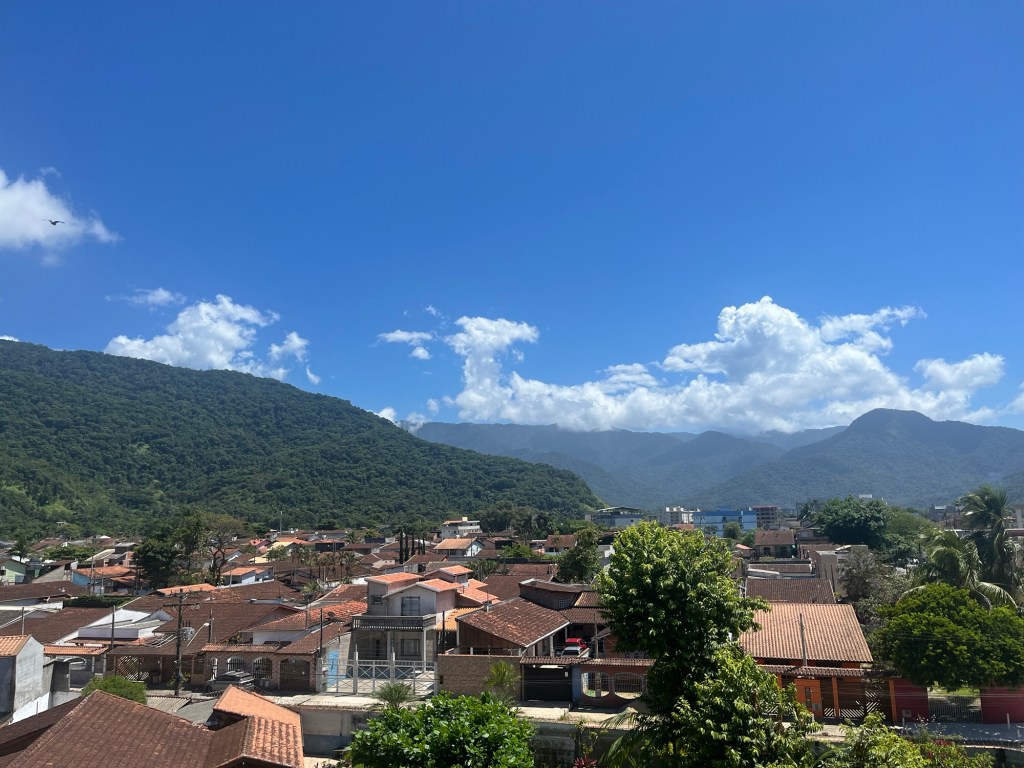
We thought about Thailand. Considered the wild energy of Rio. But instead, we landed on something quieter: Ubatuba, a coastal town on the northern edge of São Paulo state. Known as the surf capital of the region, it wears the title effortlessly.
I flew from Newcastle to Heathrow, then onward to São Paulo. After meeting my friend at the airport, we hopped on a bus and drove the winding four-and-a-half-hour road to the coast, arriving just as Carnival was beginning—but here, celebrations hum rather than roar. Ubatuba is no Rio. And that’s the charm.
We stayed in a minimalist Airbnb, just steps from the sea, with a rooftop pool overlooking the coastline. That first evening, we wandered out and found a local pizza spot—one of many, as I’d come to learn. Pizza is everywhere here, usually served in portions for two. It takes a little negotiation, especially when tastes differ. It worked for us, but certainly something to bear in mind.
Mornings began with coffee at Padaria Pão e Vinho, a quiet little café tucked along the walk to Praia Perequê-Açu. Days melted into hours on the beach—watching surfers carve through waves and barefoot football games in the sand. We sipped caipirinhas and let time slow down. The beachfront is dotted with casual cafés & plastic chairs – no sunbeds in sight.
It rained twice in nine days— the downpours flooded the streets and kept us inside. But even that felt like part of the rhythm. We listened to the storm from our balcony, watched Netflix, let the hours pass.
Ubatuba has no shortage of places to eat and drink. One night, we made our way to Taco Surf, a little Mexican place in town I’d happily recommend. Açai is everywhere and absolutely worth indulging in—cold, deep purple, and perfect under the sun.
Safety is often a question in Brazil, but Ubatuba felt calm. Usual precautions apply – keep your valuables discreet & don’t wear gold—it’s simple. Beyond that, the town felt easy.
English isn’t widely spoken here – I got by with the help of my Argentinian friend, so make sure to brush up on your Portuguese (or even your Spanish) before arriving in Ubatuba.
If you go:
- Stay near the beach.
- Don’t overschedule—Ubatuba isn’t for rushing.
- Drink caipirinhas.
- Eat açai.
- Visit the aquarium.
If you’re planning a trip to Ubatuba and still need to sort out where to stay, I’ve got a link that might come in handy. It’s what I use to browse hotel options—it’s easy to compare places and prices all in one spot.
It wasn’t Rio. But I wasn’t looking for Rio. I was looking for quiet sun, long mornings, and a breath of space after the rush of life. Ubatuba was exactly that.
 Molly Levi Travels